In the rapidly evolving landscape of cloud computing, organizations are often faced with the challenge of selecting the right platform to meet their infrastructure and service needs. Among the leading providers are Oracle Cloud Infrastructure (OCI), Amazon Web Services (AWS), Microsoft Azure, and Google Cloud Platform (GCP). Each offers a unique set of features, pricing models, and performance capabilities. This article provides a comparative overview of OCI with its major counterparts, highlighting key differences across services, pricing, and overall performance to guide informed decision-making.
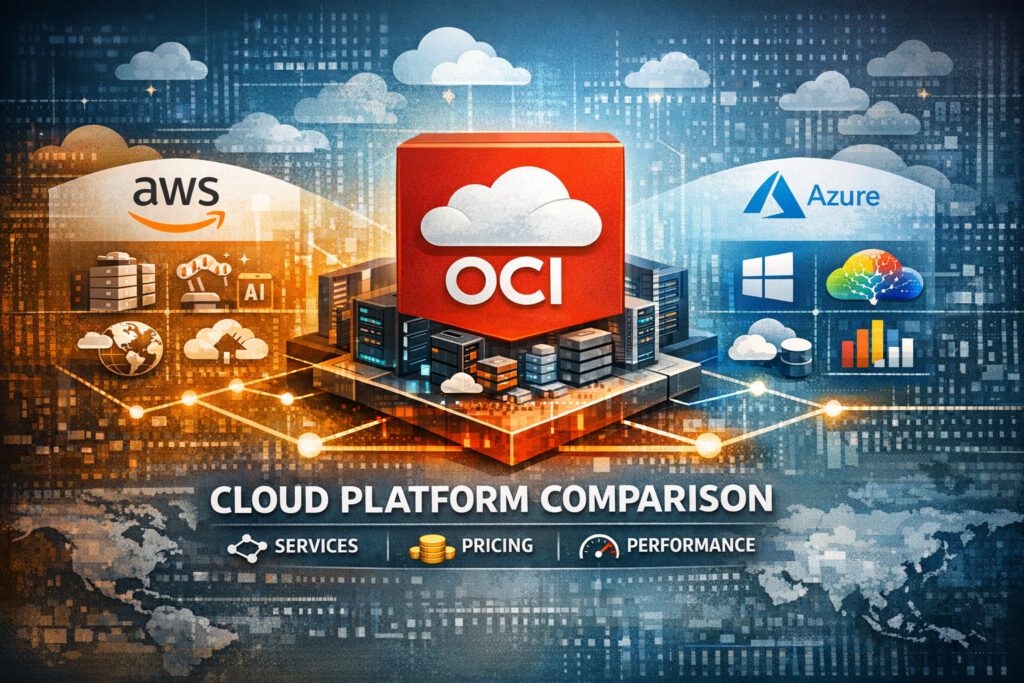
Overview of Oracle Cloud Infrastructure (OCI) and Its Core Features
Oracle Cloud Infrastructure (OCI) is a comprehensive cloud platform designed to deliver high-performance computing, storage, and networking capabilities tailored for enterprise workloads. Built with a focus on security, scalability, and reliability, OCI offers a range of core features including virtual machines, bare metal servers, autonomous databases, and extensive networking options such as Virtual Cloud Networks (VCNs) and FastConnect for dedicated connectivity. Its architecture emphasizes low latency and high throughput, making it well-suited for data-intensive applications like databases, analytics, and enterprise resource planning (ERP) systems. Additionally, OCI provides integrated security features, advanced monitoring tools, and support for hybrid cloud deployments, positioning itself as a robust choice for organizations seeking to optimize their mission-critical workloads.
Comparing OCI with Major Cloud Providers: AWS, Azure, and Google Cloud
When compared to AWS, Azure, and GCP, OCI stands out with its enterprise-oriented design and emphasis on high-performance infrastructure. AWS is the most mature and widely adopted cloud platform, offering an extensive ecosystem of services, a vast global footprint, and innovative features like serverless computing and machine learning. Azure integrates seamlessly with Microsoft products, making it a preferred choice for organizations heavily invested in Microsoft technologies. Google Cloud excels in data analytics, artificial intelligence, and machine learning capabilities, supported by its strong network infrastructure and open-source integrations. OCI differentiates itself through its focus on high-performance database services, cost-effective bare metal servers, and dedicated connectivity options, making it particularly appealing for enterprises requiring robust, predictable performance for critical workloads.
Key Differences in Services, Pricing, and Performance Among the Platforms
The platforms differ significantly in their service offerings, pricing models, and performance characteristics. AWS provides the broadest range of services, including a vast array of specialized options like IoT, robotics, and advanced AI. Azure offers tight integration with Windows Server and Office 365, along with hybrid cloud solutions such as Azure Stack. Google Cloud is noted for its leadership in data analytics, machine learning, and open-source tools. Pricing structures vary, with OCI often positioning itself as a cost-effective alternative, especially for high-compute and database workloads, thanks to its competitive bare metal and licensing options. Performance-wise, OCI emphasizes low latency and high throughput, particularly for database and enterprise workloads, while AWS and GCP excel in scalability and innovation for a broader set of use cases. Azure’s performance is optimized for hybrid and Windows-centric environments, creating a different value proposition. Ultimately, the choice depends on the specific requirements of the workload, budget, and existing ecosystem integrations.
In conclusion, while all four cloud providers offer robust and scalable solutions, their core strengths and focus areas differ. OCI’s enterprise-centric approach, cost efficiency, and high-performance infrastructure make it a compelling choice for organizations with demanding database and enterprise workloads. AWS remains the leader in service diversity and global reach, Azure offers seamless integration with Microsoft products, and Google Cloud excels in data analytics and AI capabilities. Understanding these key differences enables organizations to select the platform that best aligns with their strategic goals and technical needs.