Oracle Cloud Infrastructure (OCI) is a comprehensive cloud platform designed to support a wide range of business needs, from simple applications to complex enterprise systems. Its core services form the foundation of cloud deployment, providing the essential components for computing, storage, networking, databases, and security. Understanding these core services is crucial for organizations aiming to leverage OCI’s capabilities to enhance scalability, reliability, and security. This article offers an overview of OCI’s core services, detailing their features and how they work together to create a robust cloud environment.
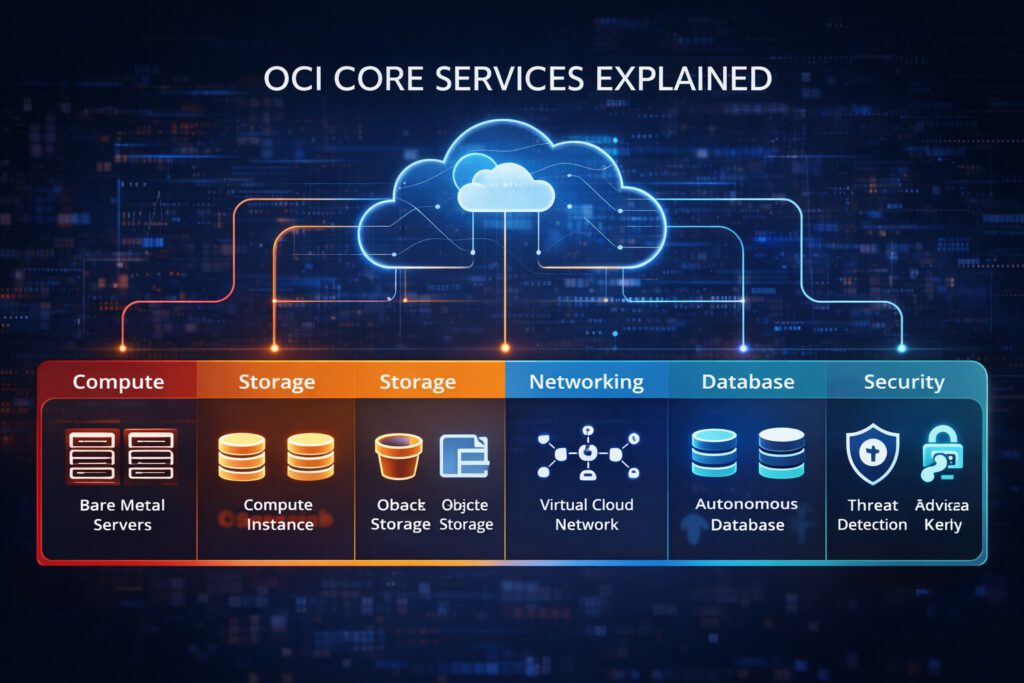
Overview of Oracle Cloud Infrastructure (OCI) and Its Core Services
Oracle Cloud Infrastructure (OCI) stands out as a high-performance, secure, and scalable cloud platform tailored for enterprise workloads. Its core services are designed to support a flexible and integrated cloud environment, enabling organizations to deploy, manage, and scale resources efficiently. These services include compute instances, storage options, networking solutions, database offerings, and security features that collectively form the backbone of OCI’s infrastructure. By providing a unified platform, OCI allows businesses to run diverse workloads while maintaining control over their environment with comprehensive management tools.
At the heart of OCI are its modular services that can be combined to meet specific operational requirements. Compute services provide virtual machines and container options to run applications, while storage solutions ensure data durability and accessibility. Networking services facilitate secure and reliable communication within and outside the cloud environment, and database services support various data management needs. Security features such as identity management, encryption, and access controls are integrated throughout the platform, ensuring data integrity and compliance. This interconnected ecosystem makes OCI a versatile environment suitable for a broad spectrum of enterprise applications.
OCI’s architecture emphasizes high availability, scalability, and security, making it suitable for mission-critical workloads. Its global data centers enable geographic distribution, reducing latency and enhancing disaster recovery capabilities. The platform also offers automation and management tools that simplify resource provisioning, monitoring, and maintenance. As a result, organizations can focus more on their core business objectives while leveraging OCI’s robust infrastructure to support their digital transformation initiatives.
Exploring OCI Compute: Virtual Machines and Container Options
Compute services in OCI provide the fundamental resources required to run applications and workloads efficiently. Virtual Machines (VMs) are a primary offering, allowing users to create customizable instances with various shapes, operating systems, and configurations. These VMs are ideal for traditional workloads, development environments, and applications requiring dedicated hardware resources. OCI also supports auto-scaling capabilities, enabling dynamic adjustment of VM capacity based on workload demands, which helps optimize costs and performance.
In addition to VMs, OCI offers container-based compute options that cater to modern, microservices-oriented architectures. Oracle Container Engine for Kubernetes (OKE) is a managed Kubernetes service that simplifies container orchestration, deployment, and management. Containers provide a lightweight, portable way to package applications, making it easier to develop, test, and deploy across different environments. OCI’s container services integrate seamlessly with other infrastructure components, providing a flexible platform for building scalable, resilient applications.
Both VM and container options in OCI are designed with security and efficiency in mind. Virtual machines can be isolated within virtual networks, and security features such as encryption and identity management are integrated into the compute layer. Containers benefit from OCI’s robust networking and storage services, ensuring they can operate securely and reliably at scale. Together, these compute options enable organizations to choose the most appropriate deployment model, whether traditional or modern, for their specific application needs.
OCI Storage and Networking: Building a Reliable Cloud Environment
Storage solutions in OCI are designed to provide durable, scalable, and high-performance data management capabilities. Block Storage offers persistent, high-speed storage volumes that can be attached to compute instances, suitable for databases, applications, and file systems. Object Storage provides a cost-effective, scalable solution for storing unstructured data such as backups, logs, media files, and archives, accessible via simple APIs. File Storage is another option, delivering shared file systems that support multiple instances, ideal for workloads requiring shared access to data.
Networking forms the backbone of a secure and efficient OCI environment. OCI’s Virtual Cloud Network (VCN) enables users to create isolated network segments within the cloud, complete with subnets, route tables, and gateways. Features such as security lists and network security groups allow fine-grained control over inbound and outbound traffic, enhancing security postures. Additionally, OCI supports load balancing, VPNs, and dedicated connections like FastConnect, which provide reliable and high-speed links between on-premises infrastructure and OCI, ensuring seamless hybrid cloud architectures.
Together, OCI’s storage and networking services work synergistically to build a resilient cloud environment. The flexible, scalable storage options ensure data availability and performance, while the robust networking capabilities facilitate secure, low-latency communication. This combination allows organizations to architect cloud solutions that are not only reliable and secure but also adaptable to changing workload demands. Properly configured, these core services form the foundation for deploying comprehensive cloud applications and services.
Securing and Managing Databases within OCI Infrastructure
Database services in OCI are designed to support mission-critical data management with high availability, security, and performance. Oracle Autonomous Database, one of OCI’s flagship offerings, uses machine learning to automate database tuning, patching, security, and backups, reducing administrative overhead and enhancing reliability. In addition, OCI provides Oracle Database Cloud Service, which allows for customizable database deployment tailored to specific workloads, whether OLTP, data warehousing, or mixed environments.
Security is a fundamental aspect of OCI’s database management, with built-in features such as encryption at rest and in transit, access controls, and audit logging. Identity and access management (IAM) policies regulate who can access or modify database resources, ensuring compliance and data protection. Furthermore, OCI integrates with other security services like Web Application Firewall (WAF) and DDoS protection, creating a comprehensive security framework that safeguards sensitive data from threats and vulnerabilities.
Managing databases within OCI involves leveraging its automation and monitoring tools to optimize performance and ensure data integrity. Automated backups, point-in-time recovery, and replication capabilities provide resilience and disaster recovery options. OCI’s management console and APIs enable seamless provisioning, scaling, and maintenance of databases, empowering organizations to focus on their data-driven initiatives without worrying about underlying infrastructure complexities. This holistic approach to database management within OCI ensures data availability, security, and operational efficiency.
Oracle Cloud Infrastructure’s core services—compute, storage, networking, database, and security—form a cohesive and powerful foundation for deploying and managing cloud applications. By offering flexible options tailored to diverse workloads and emphasizing security and automation, OCI enables organizations to build reliable and scalable cloud environments. Understanding these core components is essential for leveraging OCI’s full potential and driving digital transformation initiatives effectively.