In the realm of cloud computing, understanding the underlying infrastructure is essential for designing reliable, scalable, and secure applications. Oracle Cloud Infrastructure (OCI) offers a sophisticated global network of data centers structured to optimize availability and resilience. Central to this architecture are concepts such as regions, availability domains, and fault domains. These components work together to provide users with robust cloud services capable of withstanding failures and ensuring high uptime. This article aims to clarify these foundational elements, exploring how OCI’s infrastructure is organized to support resilient cloud deployments.
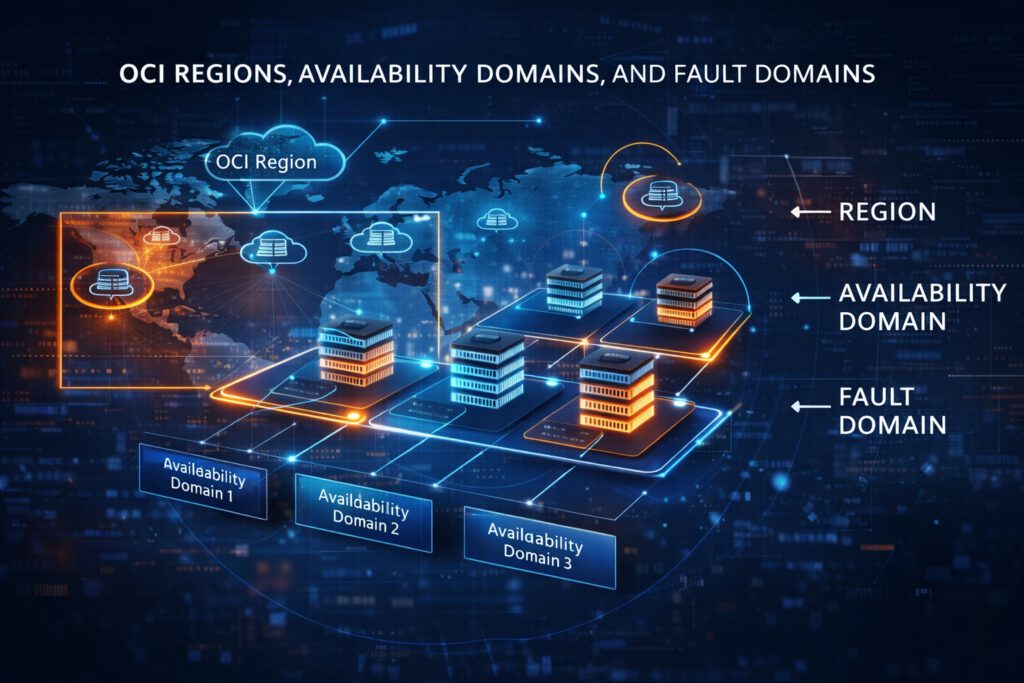
Overview of OCI Regions and Their Global Infrastructure
OCI regions are geographically dispersed data center clusters that form the backbone of Oracle’s global cloud infrastructure. Each region is a separate geographic location, often containing multiple availability domains, and is designed to serve customers with low latency and high performance. These regions are interconnected through high-speed, redundant network links, enabling data replication, disaster recovery, and global service distribution. The strategic placement of regions around the world allows organizations to comply with regional data sovereignty laws, reduce latency for end-users, and architect geographically resilient applications. Overall, OCI’s global infrastructure is built to provide a scalable, reliable, and compliant cloud environment that supports diverse enterprise needs across different regions.
Exploring Availability Domains and Their Role in Service Continuity
Within each OCI region, the infrastructure is divided into multiple Availability Domains (ADs), which are isolated data centers designed to operate independently. Each AD has its own power, networking, and cooling resources, ensuring that failures in one do not directly impact others. This separation enhances service continuity by allowing workloads to be distributed across multiple ADs, thereby reducing the risk of complete service outages due to localized failures such as hardware issues, network disruptions, or power outages. By deploying resources across multiple ADs within a region, organizations can implement high availability architectures, perform maintenance without downtime, and ensure that their applications remain accessible even during adverse events. Availability Domains thus serve as the fundamental building blocks for designing resilient cloud solutions.
Understanding Fault Domains and Enhancing System Resilience
Fault Domains (FDs) are subdivisions within an Availability Domain that further isolate potential points of failure within the data center infrastructure. Each AD is divided into multiple FDs, with each FD encompassing a subset of hardware resources such as servers, network switches, and power supplies. By distributing compute instances and storage across different FDs, users can minimize the risk that a single hardware failure will impact all their resources. This strategic placement enhances system resilience by allowing workloads to survive hardware or network failures within the same AD. Administrators can also control the placement of resources across FDs to optimize load balancing and fault isolation, thereby strengthening the overall robustness of their cloud environment. Fault domains are a critical feature for achieving high availability and fault tolerance in complex cloud architectures.
Understanding the distinctions and relationships between OCI regions, availability domains, and fault domains is vital for designing resilient and efficient cloud solutions. Regions provide a global footprint, availability domains offer localized fault isolation, and fault domains enable granular failure containment within data centers. Together, these elements empower organizations to build highly available, fault-tolerant applications that can withstand various failure scenarios, ensuring continuous service delivery and optimal performance in the cloud.